The Hidden Muscles Controlling Your Spine
Meet the Suboccipitals: Your Neurological Control Center
If I asked you to name the most sensitive muscles in your body, you might think of your hands, feet, or maybe your jaw. However, the most sensitive muscles sit tucked beneath the base of your skull — the suboccipitals (SOSs).
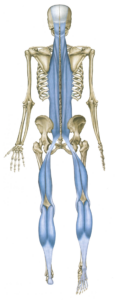
These small but powerful muscles form the upper part of the Superficial Back Line — the posterior myofascial chain that connects your eyes, neck, and spine all the way down your back body and into the soles of your feet (pictured below).
Think of the suboccipitals as a neurological control center. What happens deep within these muscles influences spinal posture, headaches, and even conditions such as plantar fasciitis.
Eye Connection = Spine Connection
Your suboccipitals connect directly to your eye movements. Every time your eyes shift, these small muscles adjust to refine the posture of your head and neck. In fact, the entire spine listens on a deep neurological level to what is happening within these sensitive muscles. How you use your eyes influences the tone of your entire spine.
As a result, if you spend your day leaning forward into patients, screens, or equipment, the suboccipitals remain in a shortened and compressed state. Forward head posture and upper cervical hyperextension increase this load. Over time, that compression decreases extensor tone throughout the ENTIRE spine.
The spine does not operate in isolation. Vision, posture, and myofascial tone function as an integrated system.
Nervous System Stress
The suboccipitals sit very close to where the spinal cord passes through the base of the skull. Consequently, it does not take much compression in this region to influence neurological function.
That proximity helps explain why tension and compression here can trigger:
• Headaches and migraines
• Heightened nervous system stress
• A general feeling of fatigue or being “fried”
• Neck and upper spinal pain
When these muscles remain tight and compressed, neurological signaling shifts toward protection and reinforces flexion-based holding patterns throughout the spine.
The Daily Downward Gaze Problem
Looking downward for most of your day decreases the extensor tone of your entire spine. Let that land…
Whether you are charting, scrolling, leaning over a patient, or slumping on the couch, this posture tells your nervous system that flexion is the dominant pattern. Over time, the body adapts to that signal.
As a result, the spine begins to behave as though it is designed to live in flexion. Extensor strength diminishes and thoracic mobility decreases. The head drifts forward. The longer this pattern persists, the more the system believes it is normal.
Your myofascial body always adapts to what you ask it to repeat.
Spine Reset Exercise: Seated Thoracic Extension with Vision Shifts
This drill restores thoracic extension while re-engaging the neurological link between your eyes and spine. It is simple, portable, and ideal for clinical environments.
Set-Up
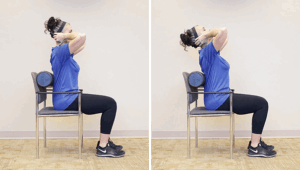
- Place a soft roller or a soft squishy ball anywhere along your thoracic spine (the region between just above your belly button and below your neck).
- Sit tall with feet firmly planted on the floor. Maintain a neutral pelvis — avoid arching the lower back or tucking the tailbone under.
- Interlace your fingers behind your head. Hook your pinkies gently under the occipital ridge while your thumbs rest along the sides of the neck.
- Aim to traction your neck upwards, but do not hyperextend it. Support it and gently create length.
Movement Sequence
- Keep your head where it is and move only your eyes.
- Shift your gaze strongly upward toward the ceiling, then return to center. Repeat 6–8 times. The head remains supported and the spine stays still.
- After completing the vision shifts, inhale and, while gazing upward, gently extend your thoracic spine (everything from the belly button upward) toward the ceiling. The spine extension should originate from the mid-back, not the lower back or neck.
- Return to center and repeat.
- Maintain a neutral pelvis throughout.
- Repeat 2–3 sets. Move your prop to different areas of the thoracic spine to influence all twelve vertebrae.
- Perform this reset 2–3 times during your workday.

After 3 set’s, notice the change. Most people feel an immediate increase in spinal extension and a lightness through the upper back. Vision feels clearer. Breathing feels easier. Small neurological resets can create meaningful structural shifts.
Give Your Eyes a Break
Because your eyes and suboccipitals function as close partners, intentional “eye breaks” throughout the day can re-energize your entire spine.
Sit or stand tall with the best posture you can muster. Then move your eyes only — not your head.
If possible, look out a window as you do this.
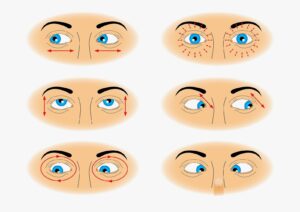
Simple Eye Reset Sequence
- Side to Side — reduce fatigue (5 reps)
- Circles — improve circulation and decrease tension (3 each direction)
- Open Wide — exaggerate eye opening and engage the surrounding muscles (3–5 reps)
- Diagonals — improve coordination and flexibility (5 each direction)
- Up and Center — reinforce spinal extension (10 reps)
The Takeaway
The work you do is visually intensive. Therefore, your spine adapts to where your eyes spend their time.
When you intentionally restore thoracic extension and retrain your visual patterns, you interrupt the flexion-based holding strategy that dominates most clinical days. As a result, extensor tone improves, postural endurance increases, and nervous system stress decreases.
Your suboccipitals may be small, but their influence is significant. By dedicating a few minutes each day to thoracic extension and eye-mobility drills, you support spinal health, reduce headaches, and help regulate your nervous system.
Small inputs. Big neurological returns.
If you want to deepen this work, read my companion blog:
Say YES to a Stronger, Smarter Neck https://kellermethodvitality.com/blog/say-yes-to-a-stronger-smarter-neck/