Why Your Neck Deserves a Second Look
The Hidden Strain in Your Deep Anterior Neck and the Base of Your Skull
If you are a dental, medical or healthcare professional, your work demands precision. However, it also demands positions that challenge your body. Hours of leaning forward, rotating, and maintaining static postures compress and stress the suboccipitals — small, deep, highly sensitive muscles at the base of the skull.
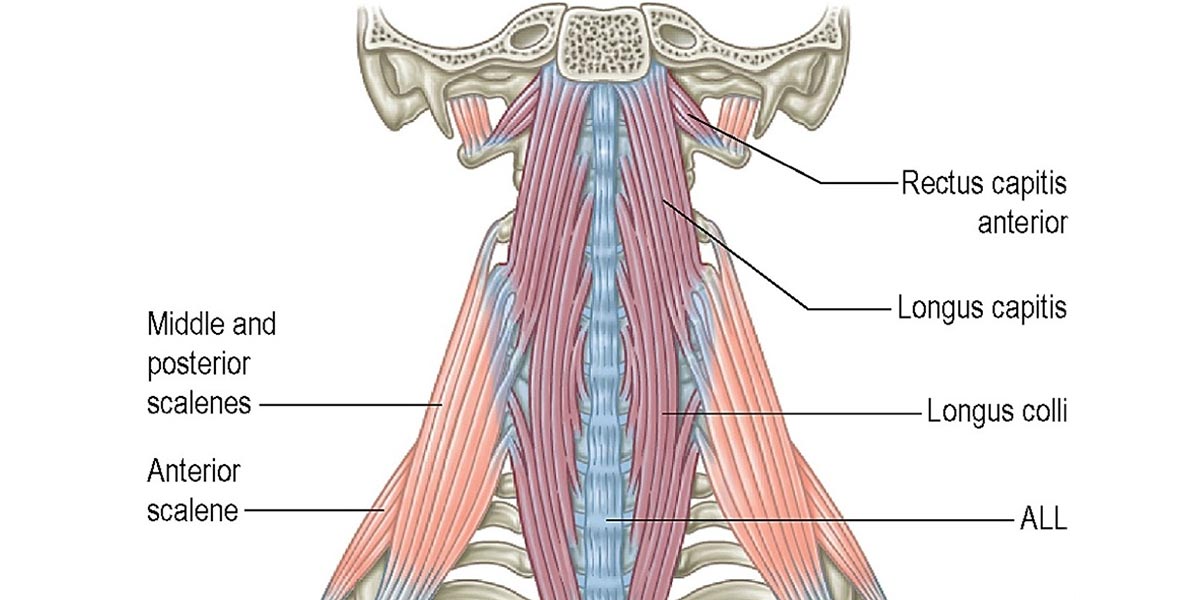
At the same time, weakness often develops in the deep neck flexors (DNF) — the longus colli and longus capitis — which serve as the primary stabilizers at the front of your neck. These muscles form part of the Deep Front Myofascial Line and, together with other deep core structures (pictured below), they create the true postural “core” of the neck.
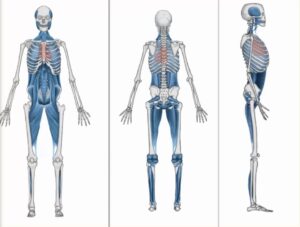
When the deep anterior neck (longus colli and capitis) loses balance with the deep posterior neck (suboccipitals), a familiar chain of strain begins:
• Tightness at the base of the skull
• Limited neck rotation
• Shoulder and upper-back tension
• Headaches or visual strain
• A heavy, fatigued neck by day’s end
As this imbalance continues, the spine adapts. Myofascia stiffens and dehydrates. Eventually, discomfort begins to feel normal.
Why Strength in the Deep Front Neck Matters
In daily life, the deep neck flexors should work in harmony with the surrounding neck, shoulder, and upper-back muscles to support the head directly over the shoulders. However, when these important stabilizers become weak and chronically lengthened, they can no longer perform that role effectively.
Your head weighs between eight and twelve pounds. For every inch it shifts forward, the load on your cervical spine increases significantly — often by roughly ten additional pounds. As a result, the upper back and shoulders compensate for a job the deep stabilizers should manage.
Over time, this imbalance contributes to forward-head posture, persistent tension, and a chain reaction of stress down the spine.
That is why retraining the deep neck flexors with a floor-based exercise such as the “Yes Nod” is so effective. Working in a gravity-reduced position builds neuromuscular awareness and strength. Later, that improved control transfers into sitting, standing, and working positions — exactly where you need it most.
The “Yes Nod”: A Small Move with a Big Payoff
A staple in Rehab Pilates, this exercise addresses both ends of the problem. It lengthens the overworked suboccipitals while simultaneously strengthening the deep anterior stabilizers that hold your head where it belongs.
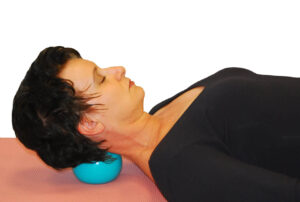
When practiced correctly and consistently, it retrains your muscle-firing sequence to stabilize the neck before movement begins and while holding static positions. As a result, tension decreases, posture improves, and the overloaded neck-and-shoulder complex begins to calm.
“YES NOD” — Length + Strength
🎥 Watch the “Yes Nod” video demonstration here
Equipment
Small, soft ball under the suboccipital ridge (a ChiBall with minimal air works best) https://chiballcanada.com/
Or use a small rolled towel or a different small soft ball
Start Position
Lie on your back with knees bent and feet flat. Maintain a neutral pelvis, (the natural curve of your lower back is present). Let your shoulders and arms relax.
Steps
- Rest your tongue gently on the roof of your mouth. This activates the hyoid system and helps the deep neck flexors engage while allowing the sternocleidomastoid (SCM) to remain relaxed.
- It is essential that the SCM stays quiet. Until you are confident it is not taking over, lightly palpate where it attaches near the collarbone or beside the sternal notch. If it activates, you will feel a large tendon pressing into your fingers. That is exactly what you want to avoid. When the SCM dominates, the purpose of the exercise is lost.
- From your starting position, gently nod “yes,” allowing the atlas and axis (the top two cervical vertebrae) to glide subtly. Think of the movement as lengthening from the base of the skull rather than tucking the chin.
- Search for a sense of solidity in the deep anterior neck and a gentle lengthening through the posterior suboccipitals.
- Hold for 4–6 seconds. Release slowly. Perform 2 sets of 8–10 repetitions.
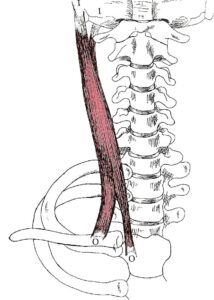
The SCM – we don’t’ want this superficial muscle to activate at all
To Advance the Exercise
Once you are certain the SCM remains quiet for the nod and, it is the deep neck flexors initiating the movement, you can progress the exercise.
- Begin by performing the “Yes” nod. Then gently lift your head off the ball and hold it up in flexion.
- Keep your gaze directed toward your belly. Do not look upward.
- Maintain a neutral pelvis and engage your deep core support.
- Start by holding for 5 seconds. Gradually build toward a 30-second hold as strength improves.
- Perform 2 sets of 8–10 repetitions.
Important Note for Any Supine Core Work
If you are performing any mat-based core work on your back, always pass through the “Yes” nod before lifting your head.
I frequently see people jam their chin toward their chest or anteriorly shear the delicate cervical vertebrae while attempting core exercises. When performed incorrectly, these strategies bypass the deep neck flexors. As a result, the workload shifts to larger, superficial muscles that were never designed to provide precise cervical stabilization.
Proper sequencing matters. The deep neck flexors must initiate the lift.
Why It Matters for Dental, Medical and Healthcare Professionals
If you spend hours in forward-leaning, precision-based postures, your neck does not need more stretching. It needs intelligent stabilization.
The Yes Nod acts as a precision reset. First, it restores balance between the deep anterior neck and the suboccipitals at the base of the skull. Then, it retrains the nervous system to stabilize before movement rather than compensate after strain.
With consistent practice, you may notice:
• Fewer headaches and reduced upper-back tension
• Improved neck rotation and postural alignment
• Greater spinal endurance throughout long clinical days
• Less fatigue in the neck and shoulders
• Better core engagement without neck strain
When the deep neck flexors function properly, the entire DEEP FRONT MYOFASCIAL LINE benefits. Stabilization at the top influences alignment all the way to the feet.
Think of the Yes Nod as training your necks postural core — subtle but profoundly powerful.
The Bottom Line
Your head is heavy. Your work is demanding. Therefore, your neck deserves lasting support.
The Yes Nod retrains your neck from the inside out. It restores balance between the deep front of the neck and the suboccipitals at the base of the skull. As a result, you build quiet, resilient strength that supports your spine during long clinical days and in daily life.
Small, precise movements create profound change.
🎥 Watch the “Yes Nod” video demonstration here . Make sure to read the advanced notes further up in this blog,
If you would like to understand ” Why Your Spine Get’s Stuck in Flexion, read the companion article:https://kellermethodvitality.com/blog/dont-let-your-spine-think-its-stuck-in-flexion/